


Directory services are a critical military component, used for tactical
and strategic systems. Military directories, specified by ACP 133, are
used to provide information services, support of military messaging,
and as supporting infrastructure for other applications such as PKI
(Public Key Infrastructure).
Military Directory Architecture
A military directory, as illustrated below is provided by a number
of directory servers. Data is replicated between servers, and data is
highly replicated. A key goal of a military directory is that the data
needed by a client will be in its local directory server. This means
that a client is only dependent on the local directory server and not
on external network access. This provides high resilience and survivability.

A military directory supports a range of applications, including direct
user access (e.g., white pages service), application by desktop applications
(e.g., mail clients) and access by applications (e.g., military messaging
servers). Access to a military directory usually uses the LDAP (Lightweight
Directory Access Protocol). Other protocols for a military directory
are specified by ACP 133 and discussed below.
There is a requirement to administer data in the military directory,
and security is critical to both data and directory administration.
Directory data is shared with partners, so the replication model of
a military directory extends to support partner directories. Data should
not be changed between directories – consistent naming is important
to enable communication and essential for secure applications relying
on digital signatures. Only selected data is replicated externally,
to save resource and to share information on a "need to know"
basis.
What Isode Provides
Isode provides all of the servers and management tools needed to build
a military directory:
- Directory Server. Isode's M-Vault
X.500 directory server is the core component of Isode’s
military directory solution providing:
- ACP 133 Conformance.
- Flexible replication.
- Security features.
- Secure Administration. Isode's Sodium
(Secure Open Data, Identity & User Manager) provides secure GUI
management of data in a military directory.
- Operational Management. Isode provides tools for operating directory
services, and integration with standard network management systems.
Together, these provide a full military directory solution.
Sodium from Isode (more information here)
Conformance
Conformance is critical for military directories. The primary definition
of military conformance is ACP (Allied Communication Publication) 133
"Common Directory Services and Procedures". ACP 133 is based
on the ISO/ITU X.500 Directory Standard, and makes use of X.500 protocols
for replication and directory management. LDAP, the Internet Standard
Lightweight Directory Access Protocol is also based on X.500, and is
generally the preferred protocol for military clients and military applications
to read data from an ACP 133 directory. Data updates are usually done
using X.500 DAP, as this offers additional security features.

Further information on the ACP 133 directory is provided in the Isode
white paper ACP 133: The Military
Directory Standard.
Directory Security & Strong Authentication
Security features are an important element of ACP 133 directory and
Isode's solution. Strong authentication and related capabilities using
digital signatures are central to directory security. All of the directory
protocols used by M-Vault make use of digital signatures based on X.509
PKI (Public Key Infrastructure) to provide peer authentication and signed
operations. PKI based security has a number of advantages for military
directory:
- It provides a higher level of security than using passwords.
- It can be used with smart cards to provide two factor authentication.
- It enables security features, such as signed operations, that cannot
be achieved with other mechanisms.
- It reduces administrative costs, particularly for server to server
configuration.
More information on strong authentication is provided in two Isode
white papers:
Signed operations enable digital signatures to be applied to every
operation and to returned results and errors. Isode recommends use of
signed operations for all directory updates, and this is straightforward
to configure in M-Vault. Further information is given in the Isode white
paper: Directory Signed Operations.
Complementing the PKI based authentication and signed operations, Isode
provides a number of important security features including:
- Access Control. X.500 gives flexible access control that is used
in conjunction with authentication to control access to and update
of data.
- Audit Logging. Isode provides detailed audit logging, which is important
for a secure environment.
Replication and Distribution
A key benefit of using a directory is that data can be highly distributed.
In a commercial environment, distribution is primarily used to optimize
performance and to avoid single point of failure. In a military environment,
there are more stringent resilience requirements, and it is critical
that local systems have minimum external dependencies. This leads to
four key points about the structure of a military directory:
- Chaining (protocol connection between two directory servers), using
X.500 DSP (Directory System Protocol), is often not used. Directory
servers are configured to either return data or to pass responsibility
back to the client.
- Need to always have a directory. Applications and users that require
directory access should not have to rely on availability of a remote
directory. This will generally mean that a military deployment will
use a larger number of servers than a commercial one, in order to
provide servers at all locations.
- Data is highly replicated, using X.500 DISP (Directory Information
Shadowing Protocol). The goal is to ensure that all data required
is held in the local server. This means that military directories
will generally make extensive use of replication.
- Security. Replication must be secure, and the strong authentication
and signed operation capabilities of DISP make it ideal.
A simplistic interpretation of this approach would lead to all data
in all servers. There are two reasons why this is not done in practice:
- Need to know. Data on people and resources should not be replicated
onto servers where there is no requirement for users to have access
to that data.
- Bandwidth and resource constraints. Often servers will be connected
with slow links. It is undesirable to spend resource on replicating
data which is not needed on the remote server.
X.500 DISP provides capabilities, which make it straightforward to
provide selective replication and meet these two requirements. This
includes attribute filtering (to remove attributes not needed), and
"chop", which enables entries and parts of the directory information
tree to be selectively replicated. This is a powerful part of the X.500
architecture, which is useful for building a military directory, and
is implemented in M-Vault.
Some military directory deployments have suggested use of directory
synchronization products (meta-directories) to achieve complex replication
scenarios. These techniques generally use LDIF (LDAP Data Interchange
Format), which relies on common interpretation of string formats, which
may not be standardized. Isode believes that this approach adds unnecessary
complexity and will reduce robustness and security. Isode strongly recommends
use of advanced X.500 DISP replication to build robust replicated directory
deployments.
Further information on use of X.500 DISP for replication to meet military
requirements is discussed in the Isode white paper Building
a Highly Replicated Directory: The case for X.500 DISP. For information
on meta-directories, the the Isode whitepaper Meta-Directories:
Cutting Through the Hype.
Client Access
Client protocol access to a military directory may use either X.500
DAP or LDAPv3. M-Vault supports both of these protocols. For applications
that make updates to the directory, Isode recommends use of X.500 DAP,
using strong authentication and signed operations. This approach, with
its security benefits, is supported by all Isode tools that modify data
in the directory.
LDAP is widely supported in many applications and LDAP provides good
functionality to access the directory, provides data confidentiality
(using Transport Layer Security (TLS)), and gives a range of authentication
mechanisms, including strong authentication when used in conjunction
with Simple Authentication and Security Layer (SASL). For applications
that only read data from the directory, LDAP is generally a good choice.
MasterKey from Boldon James (click for more detail)
End user access to Military Directory is often provided in conjunction
with military desktop support. A good solution will provide both white
pages type access to the directory, coupled with email client integration.
Isode recommends the MasterKey product from Isode partner Boldon James,
which is an LDAP directory client integrated with Microsoft Outlook.
The ACP 133 directory can also support other client applications. A
good example of this is Isode’s military
messaging solution that makes use of the ACP 133 directory to hold
configuration information. Generally this access is using LDAP, complemented
by messaging configuration management tools that use X.500 DAP with
signed operations to make configuration changes.
Managing Data in a Military Directory
A military directory holds data that needs to be managed. The tool
to do this is often referred to as an ADUA (Administrative Directory
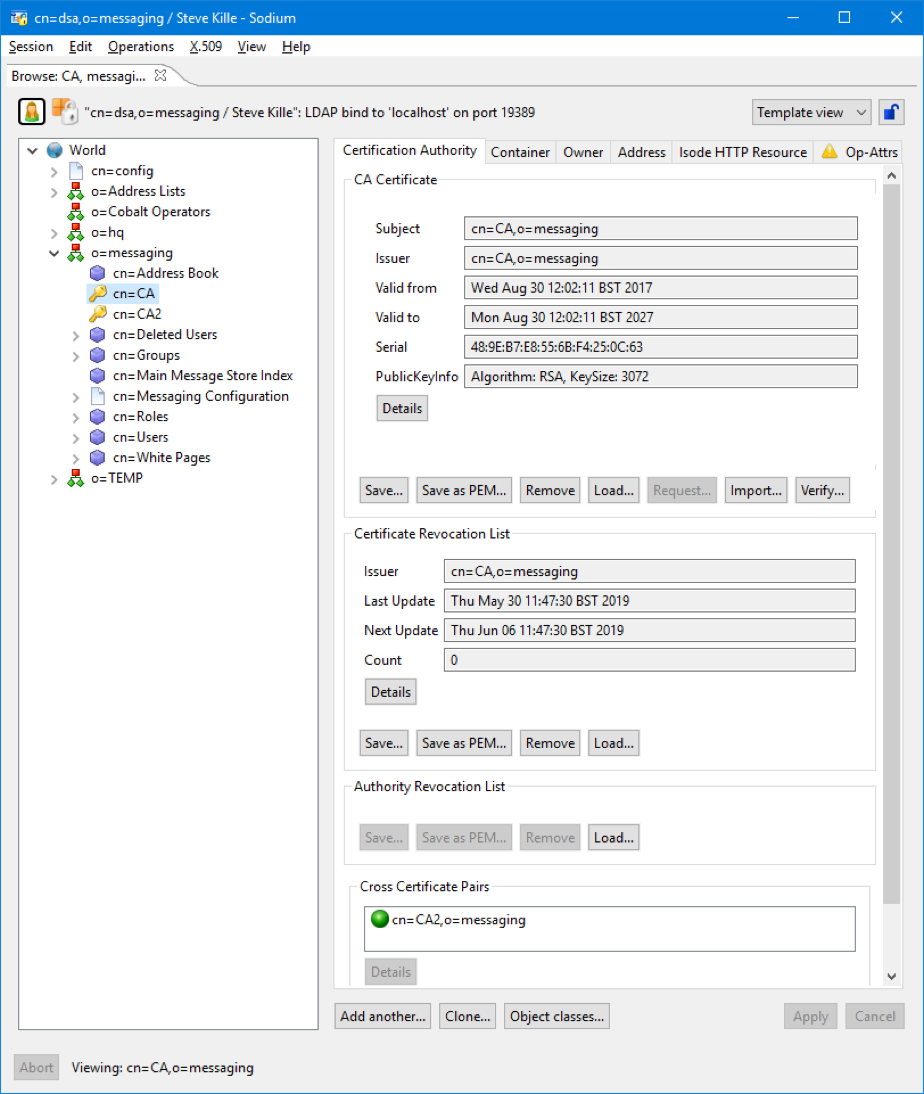
User Agent). Sodium (Secure Open Directory, User and Identity Manager)
is Isode’s ADUA. Sodium provides a flexible GUI for data administration
with features of particular importance for Military use:
- Use of Strong Authentication and Signed Operations may be chosen
for all operations.
- Support for the entire ACP 133 schema, so that any military information
may be conveniently extended.
- Display of data based on XML templates that may be adapted for local
requirements.
- Templates for convenient entry and display of structured attributes.
- Integrated management of PKI (X.509) data and associated identity
management.
Sodium from Isode (more information here)
Configuration Management
In order to set up a distributed military directory, it is necessary
to set up individual directory servers, and to manage replication agreements.
This configuration can become complex. Isode provides the EDM
(Enterprise Directory Management) tool, illustrated below, that is used
for setting up single servers and for configuring distributed operations,
security, and replication:

Operational Management
The military directory is critical infrastructure that is important
in itself and as support for other applications. It is important to
monitor servers for availability and correct operation. Isode provides
two approaches to achieve this.
This first approach is use of SNMP (Simple Network Management Protocol)
for this. Isode's M-Vault X.500 can be monitored with standard SNMP
Management tools, such as HP OpenView or Solstice Enterprise Manager.
The big advantage of SNMP is that it enables operational management
to be integrated with management of networks and other components with
a single operator interface.
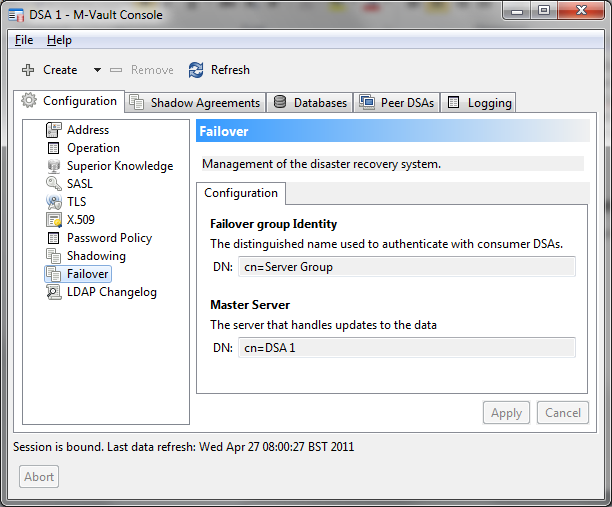
The second approach is Isode's DConsole tool (shown below), which provides
GUI monitoring of one or more M-Vault directory servers. DConsole also
has knowledge of directory replication and can monitor replication agreements
from both ends. This is important to ensure that all servers are up
to date with the most recent information.

In conclusion: Why Isode?
Isode provides a complete solution for Military directory. Important
characteristics of the Isode solution:
- Comprehensive security, including strong authentication for all
directory protocols and signed operations.
- Full ACP 133 support and conformance, including GUI support for
data administration.
- Comprehensive management and operational tools.
- Flexible replication and replication management.
- Mature and robust products deployed for many years in demanding
operational environments.